How to market a purpose-led brand without greenwashing.
There's a version of purpose-led marketing that builds extraordinary trust.
And there's a version that destroys it. Here's how to make sure you're doing the first one.
If you're reading this, you're probably already the kind of founder who loses sleep over getting this wrong. You have genuine values. Your business reflects them. The last thing you want is for your marketing to make you sound like a corporation slapping a leaf logo on a plastic bottle.
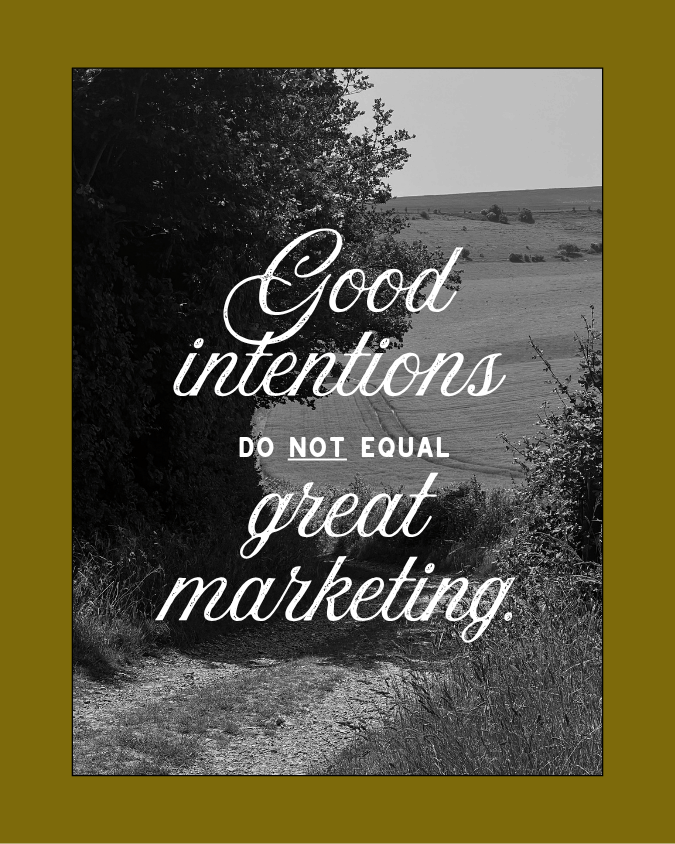
The good news is that the very fact you're asking the question puts you ahead of most. Greenwashing, and its cousins, purpose-washing and values-washing etc, almost always comes from brands trying to perform something they don't actually have. You're not doing that. But there are still traps worth knowing about, because good intentions alone don't make good marketing.
What greenwashing actually is (and what it isn't)
Greenwashing is when a brand presents itself as more ethical, sustainable or values-aligned than it actually is — usually to capitalise on the growing audience of conscious consumers without doing the underlying work.
It doesn't always look like outright lying. Often it looks like vague language ("eco-friendly," "conscious," "sustainable" with no specifics), cherry-picked claims that ignore the full picture, or leading with values as a marketing strategy rather than as a genuine reflection of how the business operates.
The distinction that matters is this: are your values something you market, or something you operate by? The former is a flag. The latter is a foundation.
The most common mistakes purpose-led founders make
Overclaiming without evidence.
Saying you're "committed to sustainability" means nothing without something to back it up. What are you actually doing? Where are your products made? What's your packaging made from? What are you still working on? Specificity is credibility.
Only talking about values when it's convenient.
If your brand leads with purpose in your marketing but your processes, pricing or partnerships don't reflect that, people will notice — especially your most engaged customers. Values need to be structural, not seasonal.
Performing rather than sharing.
There's a difference between documenting your journey honestly and crafting a narrative designed to make you look good. Audiences — particularly in the wellness, ethical fashion and maker spaces — are remarkably good at telling these apart.
Avoiding the hard stuff.
The brands that build the deepest trust are often the ones willing to say "we're not there yet" or "this is where we're still figuring things out." Honesty about imperfection is more powerful than a polished story of perfection.
What to do instead
Be specific, always.
Swap broad claims for precise ones. Not "we care about the planet" but "all our packaging is compostable and our supplier uses 100% renewable energy." If you can't be specific yet, say what you're working towards and why.
Talk about the trade-offs.
Every values-led business makes decisions that involve compromise somewhere. Acknowledging that, briefly and honestly, doesn't undermine you. It humanises you and makes everything else you say more believable.
Let your process be part of the story.
How you make decisions, who you work with, why you chose a particular supplier or material, this is genuinely interesting to your audience and it shows rather than tells. It's also nearly impossible to fake, which is why it works.
Separate your values from your marketing claims.
Your values inform how you run your business. Your marketing communicates what you offer and who it's for. These overlap, but they're not the same thing. You don't need to justify every piece of content with your mission statement. Just operate with integrity and let that come through naturally.
Build trust through consistency, not campaigns.
One-off purpose statements or annual sustainability posts don't build credibility. Showing up consistently, in how you communicate, how you respond to customers, what you choose to talk about, does. Trust is a slow build, and that's fine.
A note on the "conscious consumer" audience
The people you're trying to reach are usually thoughtful, research-oriented and quick to spot inauthenticity. They've also been burned before by brands that turned out to be nothing like their marketing. That makes them harder to win, but far more loyal once you do.
The most effective thing you can do for this audience isn't a better campaign. It's a clearer, more honest, more consistent brand.
One that knows what it stands for, says it plainly, and backs it up at every touchpoint.
That's not a marketing strategy. That's just integrity, and it turns out integrity is excellent for business.
The bottom line
You don't need to be perfect to market a purpose-led brand well. You need to be honest. Specific where you can be. Transparent about the gap between where you are and where you're heading. And consistent enough that people start to trust you before they've even spoken to you.
That's what ethical marketing actually looks like in practice. Not a set of rules, a way of operating.